

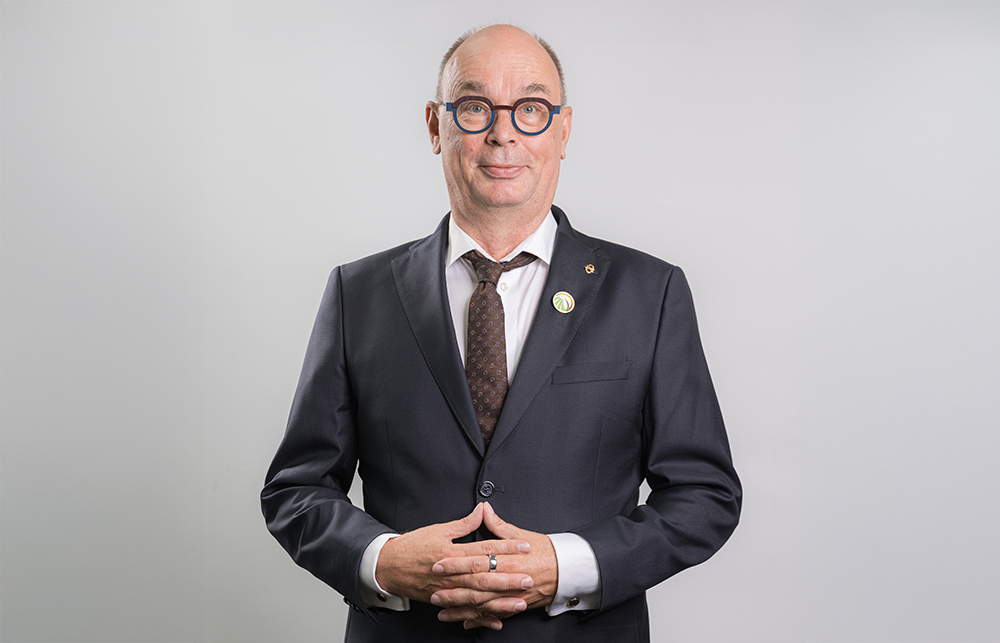
27 Nov Interview with Dr. Harri Kiiski, CEO of Brunei Fertilizer Industries, Brunei
KT: How has the establishment of Brunei Fertilizer Industries in 2013 mark a turning point in Brunei’s industrial diversification agenda and align with the nation’s long-term economic vision?
Dr. Harri Kiiski: Brunei Fertilizer Industries was founded in October 2013, and in 2017 we began constructing our world-class ammonia–urea complex, the largest in Southeast Asia. Commissioning concluded at the end of 2022, and we have been in commercial operation since 2022. Although the company is still just three years old, we have gained significant recognition in the fertilizer industry. We are one of around 30 industry stewardship champions within the International Fertilizer Association’s 500-member network. Safety is a top priority: we have achieved over 4.2 million safe working hours without injuries, medical treatments or restricted work cases – among the best in the industry. Our reliability as a supplier, along with the quality of our products and customer service, has been recognized regionally. At the recent International Fertilizer Association Crossroads Asia Conference, several customers acknowledged our performance and service.
KT: How is BFI contributing to national employment, skills development and the broader diversification of Brunei’s economy beyond oil and gas?
Dr. Harri Kiiski: When we started, over 30% of our workforce were expatriates; today that number is down to 22%, with 68% Bruneians. Around five to six years ago, we hired 160 fresh graduates, many of whom are now key operators at the plant. This reflects our commitment to developing young Bruneian talent and supports Wawasan Brunei 2035 by creating sustainable career opportunities. Last year, we outsourced maintenance operations to Brunei Rotary Engineering, a joint venture between the Brunei government and Singapore’s Rotary Company, to accelerate talent development in maintenance and strengthen cooperation with Singapore’s Jurong Island Industrial Park. Our long-term vision is to develop a similar industrial park in Brunei, attracting large companies as well as small and medium-sized enterprises, whether local, in joint ventures or foreign-invested.
KT: With BFI focusing on the production and export of granular urea, what are your main export markets and how does Brunei’s location enhance your competitiveness in global markets, particularly in Asia and the Middle East?
Dr. Harri Kiiski: Looking at a Brunei-centric map, our main markets are ASEAN countries – Malaysia, Thailand, Cambodia, Vietnam and the Philippines – which are only a few days’ sailing away. About 25% of our market is in Oceania, including Australia and New Zealand, and another 25% is on the West Coast of the Americas. We recently completed our first shipments to Chile, Peru, Colombia and Mexico.
KT: Given the strong economic and investment ties between Brunei and the UAE, what opportunities do you see for partnerships with GCC-based companies, especially in fertilizer trading, logistics or technological collaboration?
Dr. Harri Kiiski: Brunei offers significant logistical advantages, strategically located in the heart of the region with excellent air, land and sea connections. Its container port has strong development potential to support shipments to Singapore, China and beyond, while daily Royal Brunei flights connect to major hubs like Dubai. Our proximity to Singapore also supports food-security initiatives such as fish farming and agricultura – we already supply the majority of eggs to Singapore. Brunei’s education system is strong, with high literacy rates and graduates from top universities in the UK and Malaysia, all supported by His Majesty and the government.
KT: With BFI operating one of Southeast Asia’s most advanced fertilizer facilities, how is technology shaping your production efficiency, product quality and the move toward more innovative fertilizer solutions?
Dr. Harri Kiiski: Our licenses come from world-class technology providers—thyssenkrupp Uhde Fertilizer Technology, which holds 50% of the global ammonia market and leads in urea granulation, and Stamicarbon from the Netherlands, which covers 70% of global urea production. This allows sustainable fertilizer production at world-class capacities of 2,200 tons of ammonia and 3,900 tons of urea per day. Strategically located at the centre of key markets with short shipping times, our products are recognized as among the highest quality in the region.
KT: How does BFI support Brunei’s domestic agriculture and food security agenda while maintaining a strong export orientation?
Dr. Harri Kiiski: Brunei is a small country of 460,000 people, and local agriculture is limited; our fertilizer production could meet national needs in just a few hours. We work with local universities and institutions to develop fertilizers for rice cultivation, a vital crop for ASEAN countries, India and China, where 80–90% of the world’s rice is grown. Rice is deeply rooted in regional culture and critical for food security. However, agriculture faces an aging workforce – farmers in Japan average 70 years old and in the Philippines 60 – so we aim to help attract younger generations to the sector.
KT: What are your future priorities in expanding capacity, diversifying products and exploring new international partnerships, particularly with investors and industries from the GCC region?
Dr. Harri Kiiski: We aim to be a model for new entrants and welcome neighbours to our industrial park to explore synergies from urea, ammonia, steam and other by-products. We are also diversifying into specialty fertilizers, such as those with inhibitors, micronutrients and biostimulants, to address key food-security challenges. For example, zinc-deficient soils in the region affect health, particularly for women and children. Our fertilizers can improve soil health, boost root growth and increase nutrient-use efficiency, helping farmers achieve better yields while shifting from commodity products to tailored solutions.
How important is women’s empowerment within your company, and what are your current sustainability priorities?
Dr. Harri Kiiski: Women make up 28% of our workforce and 40% of our management team, and they are highly skilled and talented. Sustainability is central to our operations. Situated in a region with 100 years of oil and gas production, we see opportunities for carbon capture and storage, as well as green energy integration through the ASEAN grid to support green ammonia and hydrogen production. Using the latest fertilizer technology reduces resource consumption, while our central location cuts transport emissions by 30–40% compared to the Middle East. Specialty fertilizers with inhibitors can reduce nitrous oxide emissions from rice cultivation by 25–50%. Around 15 of our employees are trained as sustainability champions, embedding these practices throughout the company.
KT: What is your final message for the readers of Khaleej Times?
Dr. Harri Kiiski: Brunei is like an unpolished diamond full of opportunities. The country is small, well connected and surrounded by rainforest, with 80% of its land rich in biodiversity and natural beauty. Life is peaceful and smooth, with no rush-hour stress, which is why Brunei is rightly called the “Abode of Peace.” With every milestone achieved, BFI stands as a proud testament to Brunei’s and its people’s capability and ambition on the world stage – aligned with our slogan, “Making A Difference, With Bruneian Roots.” Our impact extends far beyond production and export; it lies in creating enduring value, driven by excellence and a steadfast commitment to a sustainable future.
No Comments