

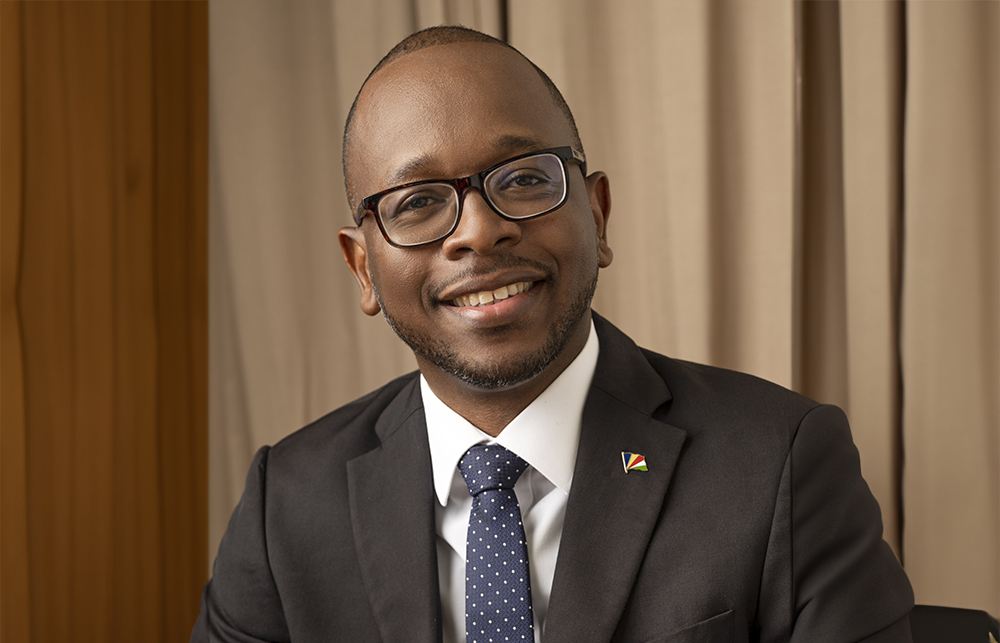
03 Feb Interview with H.E. Mr. Gervais Moumou, Ambassador, Embassy of the Republic of Seychelles, United Arab Emirates
BN: How is the Seychelles Embassy in Abu Dhabi strengthening engagement with the UAE and the wider GCC? What are your main priorities for the mission this year?
Ambassador Moumou: We aim to deepen our engagements in a more structured and forward-looking way, positioning Seychelles as a long-term strategic partner rather than a purely transactional one. Regular engagement with UAE and GCC authorities, chambers of commerce, business councils and diplomatic missions remain essential. We also place great importance on regional and international forums hosted in the region, such as Abu Dhabi Sustainability Week. Our active participation in the International Renewable Energy Agency (IRENA), which is a source of pride for the UAE and a showcase of its leadership in the energy transition, is particularly important. As Seychelles’ Permanent Representative to IRENA, I have been personally engaged in this work, encouraging high-level participation from Seychelles. Most recently, our President and several ministers attended theAbu Dhabi Sustainability Week (ADSW), where, during the IRENA assembly, our Minister for Environment, Climate, Energy and Natural Resources highlighted the challenges small island developing states face in transitioning to renewables and our goal of reaching 15% renewable energy in our mix by 2030. These platforms allow us to voice our priorities, build partnerships and seek the support needed to achieve our climate and energy ambitions. At the same time, our external engagement is guided by a simple objective: partnerships must deliver good jobs, skills transfer, and resilient supply chains that support inclusive growth and help ease everyday pressures for our people. In addition to Abu Dhabi Sustainability Week, we also participate in the World Government Summit and the Arabian Travel Market. These events are always represented at a very high level and provide important platforms to exchange ideas, share best practices and explore innovative approaches. Advancing bilateral agreements and MOUs is another key focus for the mission, particularly those related to mobility, such as visa waiver and air services agreements, which remain a priority this year. Currently, Emirates flies to Seychelles 14 times a week, alongside daily services from Qatar Airways and Air Seychelles, ensuring a steady flow of visitors from the GCC. Investment is also a priority. The mission works to position Seychelles as credible, stable, sustainable, transparent, well-regulated and ready for partnerships. Our diaspora in the UAE, nearly 500, and 800–1,000 across the GCC, mainly in aviation and hospitality, helps strengthen business, professional and people-to-people connections. This has been a focus of the mission and will continue in the year ahead.
BN: Seychelles and the Gulf share long-standing ties—what historical links or milestones do you see as most significant in shaping today’s relationship with the UAE?
Ambassador Moumou: The historical links between Seychelles and the Arab world date back centuries, even before the first settlers arrived in the 1700s. Arab mariners traveled the Indian Ocean and likely visited Seychelles, leaving cultural marks, including words in Seychellois Creole, like bazaar. Arab trade also influenced our cuisine, introducing spices that remain part of our heritage.
In terms of milestones, formal diplomatic relations with the UAE were established in 1982, followed by the opening of the Seychelles mission here in 2011 and the UAE mission in Seychelles in 2016. These steps have strengthened and deepened our bilateral relationship, showing our commitment to a long-term, sustainable partnership.
BN: In terms of cooperation, which areas are currently most strategic with the UAE and GCC—trade and investment, tourism, logistics or maritime/security collaboration—and why?
Ambassador Moumou: A major boost to our economy came in 2005, when the first Emirates flight landed in Seychelles. Starting with four flights, we now have 14 weekly services, which continue to support tourism, trade, logistics and people-to-people links. We hope to see even more connectivity, not just with the UAE, but across the GCC, where our relationships are also strong and growing. Alongside economic cooperation, maritime and security collaboration is increasingly important in the Indian Ocean, and we welcome practical partnerships that strengthen safety at sea and protect our communities.
BN: What message would you like policymakers and business leaders in the UAE/GCC to take away about Seychelles’ vision and partnership opportunities over the next few years?
Ambassador Moumou: Over the past 20 years, Seychelles has seen smooth presidential transitions, most recently in October, thanks to strong democratic institutions and mutual respect among political leaders. This stability reassures investors and allows policies to continue without disruption. Alongside economic cooperation, maritime and security cooperation is increasingly important in the Indian Ocean, and we welcome practical partnerships that enhance safety at sea and protect our communities. We focus on high-quality, sustainable tourism and investment that protect our environment. Seychelles offers a credible, transparent and well-regulated environment, with the Seychelles Investment Board guiding investors and creating an ecosystem that makes partnerships straightforward. For GCC investors, it is also a gateway to the Indian Ocean region.
BN: Is there anything else you want to add?
Ambassador Moumou: We promote opportunities in renewable energy, the blue economy and sustainable tourism, our top priority. Digital services are also a key area for investment. The UAE is Seychelles’ largest trade partner, supplying food, consumer goods and logistics services. We benefit from their strong logistics infrastructure, while we focus on improving our ports and airport to attract investment and ensure connectivity. Investment from the GCC continues to target tourism, healthcare, housing and infrastructure development. And we will continue to prioritise partnerships that are people-centre supporting stronger services, community wellbeing and long-term resilience.
No Comments